Showing posts with label Knack Stories. Show all posts

One more on Gagarin


Bill, Pete,

In keeping with historical events, I have enclosed a few snap-shots from the 1961 Pittsburgh Press dated Wednesday, April 12, 1961.
Yes, a few of us recall that very day. I had filed this newspaper in my Scrap Book back then. It was a bitter sweet thing, to read for most, as we hoped the U.S. to be first but none-the-less, we smiled anyway because, it proved a person could go into space and return. (Flight Breaks Barrier to Space Travel). I was very enthusiastic about Rockets, Travel and current events. I built my own capsule in the rafters of my parents home and spent all day up there in the tiny confines as I launched my own secret adventures into Outer-Space.

Hope you enjoy the photos. I can provide a better set of copies if you are interested.

73's

Harv - WA3EIB
Idaho Falls, ID


Harv:   I converted a small closet into what I saw as an excellent simulator of the Apollo 11 Command Module.  Bill


Our book: "SolderSmoke -- Global Adventures in Wireless Electronics" http://soldersmoke.com/book.htmOur coffee mugs, T-Shirts, bumper stickers: http://www.cafepress.com/SolderSmokeOur Book Store: http://astore.amazon.com/contracross-20

Rocket Launch, 1969


Through Facebook, I have re-established contact with my fellow members of the Waters Edge Rocket Research Society.   That's me, age 10, hitting the button on a homebrew launch controller.

Our book: "SolderSmoke -- Global Adventures in Wireless Electronics" http://soldersmoke.com/book.htmOur coffee mugs, T-Shirts, bumper stickers: http://www.cafepress.com/SolderSmokeOur Book Store: http://astore.amazon.com/contracross-20

Kirk's Herring Aid, Tuna Tin, and Regen Adventures

 
Hello Bill!
 
Just a quick hello from MN to tell you how much I have been enjoying your podcast. Although I have "plugged" your stuff in multiple magazine columns over the years, I'm a bit late getting into the listening game. My current contract job has me doing a lot of driving, however, so I now have several years' worth of soldersmoke to enjoy.
 
Several of the most recent episodes have made it clear that we have covered some common ground in our amateur radio careers.
I was licensed in 1977 at age 15 -- a year after I built my Tuna Tin 2 :) The transmitter was a smashing success. I used it with my Tempo One transceiver, or at the electronics repair shop at a local National Guard base (where my mom worked as a civilian administrator). I would ride my bike to Camp Ripley (only 8 miles or so), and the guys in the signal shop would let me use the shop's Collins KWM-2 HF transceiver (and attached dipole). Other than my efforts, I don't think the KWM-2 got much use...
 
I, too, tried to get the Herring Aid 5 to work, with no luck at all. Listening to your podcast was like being in a time machine of sorts :) I wonder if I got the "sense" of the oscillator secondary messed up? I never did get that thing to make even a sound. I don't have it any longer. The same goes for the TT2. They got "lost" when I stored a bunch of stuff at my dad's place in-between moves, as did a home-brew 4-400A amplifier and a 6146B amplifier for my Ten-Tec Argonaut. Darn!
 
Don't forget about the matching VFO -- the Chopped Beef Slider (CB Slider), which was built into a chopped beef can, of course! I didn't build one, but as I recall it was a diode-tuned 40-meter VFO for the TT2.
 
Your "regen rage" and its subsequent easing was also amusing. I have had a love-hate relationship with those buggers, too, although mine was mostly love. You referenced Dave Newkirk's (now W9VES) 40-meter QST regen article in a podcast. I was fortunate enough to be a QST editor at the time Dave was in his "second residence." That guy forgot more about receivers than I will ever know, and he helped me tremendously in official and unofficial capacities.
I have attached a photo (above) of a multiband regen that Dave helped me build (he designed and dispensed wisdom while I built the radio). He took a schematic from a 1930s ARRL Handbook and tweaked it a bit, helping me add a VR tube, "more modern" tubes and a few other goodies. Just to be difficult, I sampled the tank circuit with a tiny-value capacitor and a high-gain MMIC amplifier so I could drive a frequency counter, which displayed the receive frequency as long as the tank was oscillating. It was fun, but it was difficult to isolate the digital noise from the counter, so I only really turned on the counter as necessary, or to calibrate a dial, etc. The chassis used to be an Eico audio signal generator... In the photo the Jackson Brothers dial and bezel/tuning scale isn't completely installed. After sitting in a box for 25 years, the regen still works but probably needs new tubes, as it's rather deaf :) Blasphemy aside, I'm moving on to solid-state regens...
 
I, too, just got a Rigol DSO. Wow, the "one-button" measurement is almost too easy.
 
I'm prepping my book, Stealth Amateur Radio, for release on the Kindle (and maybe other e-book formats), but it's available now from my website, www.stealthamateur.com.
 
Keep up the good work, Bill.

I'll be listening. :)

73,

--Kirk Kleinschmidt, NT0Z
  Rochester, MN

Editor, 1990 ARRL Handbook
Technical Editor, Ham Radio for Dummies
QST Assistant Managing Editor, 1988-1994
Ham Radio Columnist since 1989 for:
   Popular Communications
   Monitoring Times and now,
   The Spectrum Monitor (www.thespectrummonitor.com)
My book, "Stealth Amateur Radio," is now available from
www.stealthamateur.com and on the Amazon Kindle (soon)

Our book: "SolderSmoke -- Global Adventures in Wireless Electronics" http://soldersmoke.com/book.htmOur coffee mugs, T-Shirts, bumper stickers: http://www.cafepress.com/SolderSmokeOur Book Store: http://astore.amazon.com/contracross-20

American Radio History Site -- Lots of Radio Magazines

 
Hi Bill,

I wanted to leave you feedback on your podcast.

I love it!  Keep it up.  I travel quite often in my work and listen to
all your podcasts.

Since my early teens in the late 70's I started subscribing to
electronic magazines (which I have still keep all every issue).  I just
found a site that has all the old electronic magazines scanned and
posted for all to read.  What a resource!
http://www.americanradiohistory.com 
It has all the old Popular
Electronic Magazines, Radio Electronic Magazines, Modern Electronics,
Electronics Illustrated, etc, in pdf format. Information from the turn
of the century ...  Wow.  Back when radio hobbyists made their own
chassis for their valve radios.  Just google American Radio History and
it will be a top link.  You might want to share this link with your
friends, and listeners.

I have purchased your Soldersmoke book from Lulu -- Thumbs  up!! Great Book.

Thanks again for sharing your experience with radio and the knack.

Greg Self
N8YCB
ps:
I have always called  kluge -  KLOO-guh ..  and I don't know why. ;)


Our book: "SolderSmoke -- Global Adventures in Wireless Electronics" http://soldersmoke.com/book.htmOur coffee mugs, T-Shirts, bumper stickers: http://www.cafepress.com/SolderSmokeOur Book Store: http://astore.amazon.com/contracross-20

N9IZ's Steam-Rollered Indy Mighty Mite (Video)


Not even the U.S. Postal Service's Anti-Crystal Steam Roller can stop an intrepid homebrewer.  OM N9IZ got his Mighty Mite working and produced a really nice video and blog post on the project.  You can just feel the enthusiasm:  On the blog he writes:   "Everything was assembled on a bread board for trial.  I must admit to being overjoyed when I saw the visual waveform on the PowerSDR panafall display of my Flex-5000A main shack radio.  So much so, that I ran through the house calling for my YL, KC9TAH.  She was in the shower and thought I’d cut off a finger or something while in the mad scientist lair.  Much to her dismay, it was only a nasty CW signal emanating from the Flex speaker.  She did humor me by going out to see the marvelous project before asking me what I was going to fix for lunch."  FB OM!   
  
Bill
 
I thought you might like to hear that another MMM has been brought into the fold.  You might remember that the crystal you sent me was steamrolled by the USPS.  Believe it or not, it works!  Not sure the frequency is exactly spot-on, but who cares...it works!  I enjoyed it very much and made a youtube video of the testing process.  I also took pictures and posted it all to my webpage.  Most of my other projects have been more QRO in nature so I'm treading in uncharted territory.  We'll see how far that goes, but right now I'm loving it.  I have my issue of QRP Quarterly and plan to follow along in constructing the LBS project.  All for now from Hoosierland.  Hope you enjoy the blog post on my webpage.  73 OM.

DE N9IZ


Our book: "SolderSmoke -- Global Adventures in Wireless Electronics" http://soldersmoke.com/book.htmOur coffee mugs, T-Shirts, bumper stickers: http://www.cafepress.com/SolderSmokeOur Book Store: http://astore.amazon.com/contracross-20

Patrick, F6AWY, The SSB Carpenter (Homebrew Hero)

 
There he is:  Patrick, F6AWY, the builder of the beautiful wooden-case SSB transceiver featured here two days ago.   Born in 1945, Patrick has been melting solder since age 15. This picture made me think that there must be some connection between string instruments and homebrew genius:  Farhan plays guitar.   So does Pete Juliano.  I think it was Rick Campbell who was strumming the banjo at FDIM...  More about Patrick here:  http://www.araccma.com/f6awy-p821004 


Here is another of Patrick's projects.   He completely rebuilt an old Geloso AM transmitter.   Note the  markings on the front panel.  Signed with a dash of F6AWY panache! 
More about this project here:
http://www.araccma.com/emetteur-am-pas-a-pas-avec-f6awy-p820986

Translation tip:  Open these pages in Google Chrome.  Then, simply RIGHT CLICK on the page and select TRANSLATE TO ENGLISH.  


Our book: "SolderSmoke -- Global Adventures in Wireless Electronics" http://soldersmoke.com/book.htmOur coffee mugs, T-Shirts, bumper stickers: http://www.cafepress.com/SolderSmokeOur Book Store: http://astore.amazon.com/contracross-20

N6ORS's Long-Delayed SSB Rig


We've heard of a few of these "long-delayed" projects.  My own 38 year pause in the Herring Aid Five receiver project comes to mind.   I like Keith's idea of a "homebrewers home frequency" but I strongly suspect it would be a very lonely place!  Thanks for sending us the pictures of your rig Keith.  

Bill:

This project started out about 20 years ago as
a 2 meter FM handheld, then sat in boxes for decades.
Thanks to you and Pete and your podcasts keeping
me company, it morphed into a homebrew 2 meter SSB
rig.   It saw 'firstlight' last weekend. Of course
I had to operate it without the covers but I made
a short QSO, about 1 mile across town with the wife (kg6oeo).
Homebrewers should pick a "Homebrew home frequency" on
various bands to facilitate homebrew to homebrew contacts.

73,

Keith N6ORS


Our book: "SolderSmoke -- Global Adventures in Wireless Electronics" http://soldersmoke.com/book.htmOur coffee mugs, T-Shirts, bumper stickers: http://www.cafepress.com/SolderSmokeOur Book Store: http://astore.amazon.com/contracross-20

TR on Homebrewing

Theodore Roosevelt
"It is not the critic who counts; not the ham who points out how the homebrewer stumbles, or where the builder of rigs could have built them better. The credit belongs to the ham who is actually at the workbench, whose hands are scarred by solder and metal and glue; who strives valiantly; who errs, whose amp oscillates again and again, because there is no effort without error and shortcoming; but who does actually strive to build his rigs; who knows great enthusiasms, the great devotions; who spends himself in a worthy cause; who at the best knows in the end the triumph of high achievement, and who at the worst, if he fails, at least fails while daring greatly, so that his place shall never be with those cold and timid operators who neither know victory nor defeat.”

Our book: "SolderSmoke -- Global Adventures in Wireless Electronics" http://soldersmoke.com/book.htmOur coffee mugs, T-Shirts, bumper stickers: http://www.cafepress.com/SolderSmokeOur Book Store: http://astore.amazon.com/contracross-20

Parasitic Anguish on 40 then... Homebrew Transceiver Heard by Homebrew Receiver (with a PTO!)


Oh man, I was struggling yesterday. I guess I had been lulled into a false sense of security by the phenomenal ease with which I had put my BITX 17 on the air, then added a 120 watt amplifier, all without any sign of the dreaded feedback and parasitic oscillations that had plagued almost all of my previous projects.  So when I decided to add the low pass filter and the switching/relay arrangements needed to use the amplifier with my BITX 20/40 rig, I kind of expected a similar trouble-free experience.   

WRONG!  And you know what?  I think guys on 40 and 20 are a bit less forgiving and collegial than the folks on 17. As I struggled to exorcise the transceiver, I'd make some changes then hopefully go out onto the airwaves and call CQ, looking for a signal report.  Well, I got them.  Many were not accompanied by call signs.  I'd be in contact with someone who was trying to help, and -- as we were trying to figure out what it might be -- we'd be bombarded with harsh, sometimes angry, anonymous commentary: "YOU'RE 20 kcs WIDE!"  "Are you on AM?"  "You have a CARRIER!"  One fellow scornfully told me "That little QRP rig of yours is not ready for prime time."  Ouch.  (I didn't realize we were on prime time.  Isn't this AMATEUR radio?) 

Others would answer my CQ by announcing that I was "on the wrong frequency."  Others would respond (off frequency) and tell  me I was distorted -- I'd ask them to tune me in, then they would say, "Oh yea, you are OK -- you were just on the wrong frequency." Some of these guys seemed to be under the impression that there are "channels" on 40 meters.   It was a real disheartening mess.

Then came the saving grace.   I got the e-mails that appear below.  WOW! My faith in ham radio was renewed!  In the 18 months that I've been running the BITX rigs, I've never once worked another station using a homebrew rig.  But Rick and I were 3/4 of the way there yesterday.  And he was using a direct conversion receiver of his own design, with a PTO in an enclosure made from "flattened out tin-plated food tins."  Fantastic!  It was as if the radio gods had arranged all this to pull me out of the depths of parasitic despair!  Thanks Rick!    A video of his receiver picking up my BITX 20/40 appears above. 

Pete and I will talk about the actual troubleshooting in the next podcast.  I am HOPING to have it fixed by then.  I may have to sacrifice some chickens to Papa Legba." 

................

Bill,

I'm a long-time SolderSmoke podcast listener, and today one of my ham radio dreams came true.

I was listening to 40 meters today on my homebrew direct conversion receiver, and I heard your call.  At first I didn't believe it was you, but  there you were. 

At first I just sat there dumbfounded, just listening, but soon realized that I should make a video of this "rare DX" (rare DX for me hi hi), and post it on YouTube for you to review.

My apologies for the low audio in the video.  I was using my iPhone and its inboard mic leaves a lot to be desired, but the best audio of you is at 0:13, 0:50, and again at 2:12 into the video.

Heard you on 7.16 MHz, Sunday 2-22-2015 at 10:15 a.m. local east-coast time (15:15 UTC).

I'm located in Manchester Maryland (North - Central Maryland).  My homebrew 40 meter rig is a PTO tuned direct conversion receiver with all discrete components.  My antenna is a simple wire dipole about 6 feet above the ground just outside by workroom window.

Below are links to the YouTube video of your QSO , and the schematic the DSB transceiver that you were received on.  The rig is one that I designed, based on the published works of many home-brewers from the web.  I call it the Lakeside 40 (in homage to Peter Parker's Beach 40 transceiver).

So far I only completed the receiver section, and hope to complete the transmitter sometime this summer so I can use the rig at Lake Marburg (at Codorus State Park in PA), thus the "Lakeside" in the rig's name.

http://youtu.be/emsKg5n5-0c


http://www.remmepark.com/circuit6040/lakeside40.gif


73
Rick - N3FJZ


Bill,

Yes, what a coincidence with the PTO! That's the same WA6OTP PTO design
I based my PTO on.

I created a webpage tonight(very much a work in progress) so you can see
the details of how I constructed my PTO in the Lakeside 40, as well as
my rendition of a BITX 20. Click the [Permeability Tuned Oscillator], or
[My rendition of a Bitx 20] links on the left of the page.

The webpage is here:
[http://www.remmepark.com/circuit6040/index.html]

The ground plane for the Manhattan construction (and RF tight enclosure
for the PTO) are made from flattened out tin plated food cans, and the
coil-form for the PTO is cut from Masonite wall panel material with my
scroll saw.

Don't get discouraged from the less than enthusiastic response from the
others about your signal, pay them no mind; I'm sure they simply didn't
realize the significance of what it represented.  To me, your signal was
the most perfect signal I have ever heard.  It was perfect because I
know (from your pod-casts, and my attempts at homebrew) what it took for
it to be produced.  Its existence, and the fact that I successfully
received it on my little homebrew rig too, represents the fundamental
core foundation of Amateur radio; experimentation, building equipment
with your own hands from scratch, expanding ones knowledge in the radio
art, and most important, having fun and enjoying the excitement that
comes from using gear that *you* built.

I cannot put into words how significant hearing your signal was for me
today - thank you!  My biggest regret is that I didn't have a means of
transmitting yet on 40 meters, and my Bitx 20 is not ready yet, 

perhaps in the future we can have homebrew to homebrew QSO's
where we can fine-tune our designs and tweak things (however we'll have
go above 7.175 MHz, or 14.225 MHz since I only hold a General ticket at
the moment).

Rick
N3FJZ.


PTO another view.

Rick's PTO


Our book: "SolderSmoke -- Global Adventures in Wireless Electronics" http://soldersmoke.com/book.htmOur coffee mugs, T-Shirts, bumper stickers: http://www.cafepress.com/SolderSmokeOur Book Store: http://astore.amazon.com/contracross-20

World Radio Day! Article with Farhan


The Hindu did a nice article on World Radio Day.  They wisely featured someone with a true case of The Knack, someone with a strong emotional connection to radio and radios:  our friend Farhan.  

http://www.thehindu.com/features/metroplus/thank-you-for-the-radio/article6886601.ece


Our book: "SolderSmoke -- Global Adventures in Wireless Electronics" http://soldersmoke.com/book.htmOur coffee mugs, T-Shirts, bumper stickers: http://www.cafepress.com/SolderSmokeOur Book Store: http://astore.amazon.com/contracross-20

This Kid has THE KNACK TO THE MAX! And is in the International Brotherhood of Electronic Wizards! (VIDEO)


Oh man, we've all been there in one form or another.  The struggle, the frustration, then, THE TRIUMPH!  I love when his mother drops the plate.  
Thanks to John KC0BMF

Our book: "SolderSmoke -- Global Adventures in Wireless Electronics" http://soldersmoke.com/book.htmOur coffee mugs, T-Shirts, bumper stickers: http://www.cafepress.com/SolderSmokeOur Book Store: http://astore.amazon.com/contracross-20

Lucien's German Mighty Mite (Video)


Excellent Lucien!  Thanks for sending this.   I know what you mean about a project that doesn't work.  It is rewarding and educational to figure out where you went wrong.  I knew a guy who would ask, at a hamfest, "Does this rig work?"  If the the seller admitted that it didn't, he'd reply, "Good, I pay extra for that!"   He liked the challenge of fixing it.  Of course, there are limits to this, and sometimes these challenges will make you wish you had taken up stamp collecting. 

Hi Bill and Pete,

For me too, it's a happy day - I got the Mighty Mite working! Thank you so much for the inspiration to get into homebrewing...

I'm just licensed for a year now and this was my very first project (except for 2 basic kits that I build) and it really was a great learning experience. The best part: Since it didn't work out "plug'n play", I had to debug the thing and actually start thinking - so I put 2 caps in parallel instead of the wrong one I had used (I found them in a little box some guys at a hamfest gave me for free - never thought I would ever use something from it...). And I had to use the voltmeter to look for a short circuit. Basic stuff, but for me, this was a breakthrough!

Here are some more things I learned during this first project (don't laugh):
  • Where the heck do I plug stuff that's supposed to go to "ground" in? Now I know: usually to the negative pole!
  • When 2 lines cross in a schematic, that doesn't mean there's a connection!
  • How do these ready-made breadboards actually work? Had to try out...
  • It's important to think about the actual layout beforehand!
  • When debugging, trial and error doesn't help.
  • There's yet another crazy foreign unit called "gauge"! (I used smaller magnet wire than recommended, it still seems to work...)
  • 9V-blocks get VERY hot when shorted for a minute or so!
Attached is an image of my ugly prototype, now I want to give it a better "home"... And here is a little video, demonstrating that it works, inspired by IZ1KSW:


BTW, frequency is about 3,5793 Mhz.

Thanks again for all the great inspiration and vy 73 from Germany,
Lucien / DH7LM


 Our book: "SolderSmoke -- Global Adventures in Wireless Electronics" http://soldersmoke.com/book.htmOur coffee mugs, T-Shirts, bumper stickers: http://www.cafepress.com/SolderSmokeOur Book Store: http://astore.amazon.com/contracross-20

Video of Colin's First Contact with his Homebrew Scratch-built BITX20


I love this video.  Colin finished his BITX a week or so ago and has been waiting for an opportunity to test it.  Over the weekend he braved the winter of Northern England and, with his son,  set up his new rig out in his snow-covered garden.   Appropriately for a first contact with scratch-built rig, the circuitry was unencumbered by any kind of case or box.  That's the way it should be done!  Well done Colin!  You are well and truly a member of the International Brotherhood of Electronic Wizards, and the diagnosis of "The Knack" has been confirmed (a severe case, it appears). 

Hi Pete and Bill,
It's been a lovely fine day here in West Yorkshire, so I took a table out into the garden and set up my BITX circuit on it. I set up my SOTA dipole on a 9m fishing pole.
I heard a strong German station calling CQ, so I gave him a call and hoped for the best!
How amazing to contact someone in another country using a rig and mic you've made yourself! Do I qualify as a REAL radio ham now? Do I have a confirmed case of the knack? :-)

Although I may appear underwhelmed in the video, (besides the air punches!), I did really get a kick out of the QSO.
73 and huge thanks to both of you for the encouragement and support.

Colin, M1BUU


Our book: "SolderSmoke -- Global Adventures in Wireless Electronics" http://soldersmoke.com/book.htmOur coffee mugs, T-Shirts, bumper stickers: http://www.cafepress.com/SolderSmokeOur Book Store: http://astore.amazon.com/contracross-20

Jailed for The Knack: Gerry Wells, Homebrew Hero


Thanks to Thomas of the "SWLing Post" for alerting us to the story of UK radio legend Gerry Wells. As Thomas said in his post, you really need to drop what you are doing and listen to this great BBC program about Gerry: 

http://swling.com/blog/2011/02/radio-documentary-the-wireless-world-of-gerry-wells/

The poor fellow was actually JAILED for his "radio obsession."  Wow.  That was kind of harsh.  But Gerry overcame adversity and had a very happy life in radio.  

Thomas has more on Gerry here: 

http://swling.com/blog/2014/12/jonathans-interviews-with-gerry-wells/

Thanks Thomas!  And thanks to the BBC. 

Our book: "SolderSmoke -- Global Adventures in Wireless Electronics" http://soldersmoke.com/book.htmOur coffee mugs, T-Shirts, bumper stickers: http://www.cafepress.com/SolderSmokeOur Book Store: http://astore.amazon.com/contracross-20

Some Colorburst QRP Encouragement from ND6T


Don ND6T has been helping us come up with a good simple low pass filter for the MMM (Steve Smith and the FCC insist).    At the end of one of his e-mails, he shared this QRP Colorburst gem: 


Be prepared to be occasionally amazed. Back in the late 70's I worked all over the western U.S. with under 1/2 watt. Regularly. Even a QSO with a UA0 (Siberia) with under 1 milliwatt, he having answered my CQ! I was seeing if I could "get out" using a single "D" cell flashlight battery that was too weak for the flashlight. All using a colorburst crystal. Oh, and a dipole 100' high stretched over a creek.
 73/72,
Don      ND6T


Our book: "SolderSmoke -- Global Adventures in Wireless Electronics" http://soldersmoke.com/book.htmOur coffee mugs, T-Shirts, bumper stickers: http://www.cafepress.com/SolderSmokeOur Book Store: http://astore.amazon.com/contracross-20

Graham G4UEK has THE KNACK


Thanks to Stephen for alerting me to the homebrew page of Graham G4UEK:

http://www.sandrock.org.uk/radiostuff/Rigs.htm

I really liked the description of his progress as a homebrewer, and the way he was helped by G-QRP, SPRAT and Ian G3ROO.  FB.

Graham has a nice personal ham radio story:

http://www.sandrock.org.uk/radiostuff/Radio.htm

Thanks Stephen!  Thanks Graham!   

Our book: "SolderSmoke -- Global Adventures in Wireless Electronics" http://soldersmoke.com/book.htmOur coffee mugs, T-Shirts, bumper stickers: http://www.cafepress.com/SolderSmokeOur Book Store: http://astore.amazon.com/contracross-20

Bill's Dominican Mighty Mite (1993)

If you look closely, just in front of my keyboard you can see the Michigan Mighty Mite that I rebuilt this morning (scroll down to see the previous post).  Looks like I was using a polivaricon as the capacitor.  Other than the cap, all the parts used in this 2014 version were from the 1993 effort.  Here is how it is described in "SolderSmoke -- Global Adventures in Wirless Electronics"

    I decided to start off slow, with small projects that seemed likely to succeed.  The secretary in our office in the Embassy, Mady Bullen, had an interest in ham radio that had been sparked by service in far-off places where short-wave was the only way to talk to home.  She would pass me old issues of CQ magazine.  It was in the March 1992 issue that I found the Michigan Mighty Mite.
    It was originated by Ed Knoll, W3FQJ and developed by Tom Jurgens, KY8I. It is about as simple as you can get in a radio transmitter: just one stage, a crystal controlled oscillator.
    An oscillator is basically an amplifier in which some of the output signal is fed back into the input.  If you provide enough feedback in the right way, the amplifier will “take off” and begin generating a signal.  The howl you hear when the microphone of public address system gets too close to the speaker is this kind of signal.  The speaker (the output) is sending energy back to the input (the microphone) and what was an amplifier turns (annoyingly) into an oscillator.  In this case it is an audio frequency oscillator because all the filters and tuned circuits in the PA system are built for the audible frequencies.  But the same thing will happen at radio frequencies.  That’s what the Michigan Mighty Mite is all about. 
    I put the thing together using parts obtained from the Santo Domingo Radio Shack store. The resonant circuit used a coil that was just some wire wound around a discarded plastic 35mm film container.  Homebrew radio projects rarely work the first time you power them up.  I had to fidget with this thing quite a bit—obviously there wasn’t enough feedback.  I had my Drake 2-B on and tuned to the crystal’s frequency.  As I poked around on the little circuit board, I suddenly heard a little chirp from the 2-B.  There it was!  The little device that I had put together was producing radio frequency energy on the 40 meter band.  Hooray!  The joy of oscillation!  Now I felt like I was truly in league with Faraday and Marconi, with Shep, Stan and Bollis, and with Serge! Hilmar would have been proud of me (but he still would have been horrified by my sloppy wiring). 

    I never was able to talk to anyone with that little device—the power output was very low, and my antenna for the 40 meter band was very poor.  But it didn’t really matter.  I had had my first real success at homebrewing a piece of ham radio gear.


Our book: "SolderSmoke -- Global Adventures in Wireless Electronics" http://soldersmoke.com/book.htmOur coffee mugs, T-Shirts, bumper stickers: http://www.cafepress.com/SolderSmokeOur Book Store: http://astore.amazon.com/contracross-20

FINALLY! A Computer Made with Discrete Transistors!

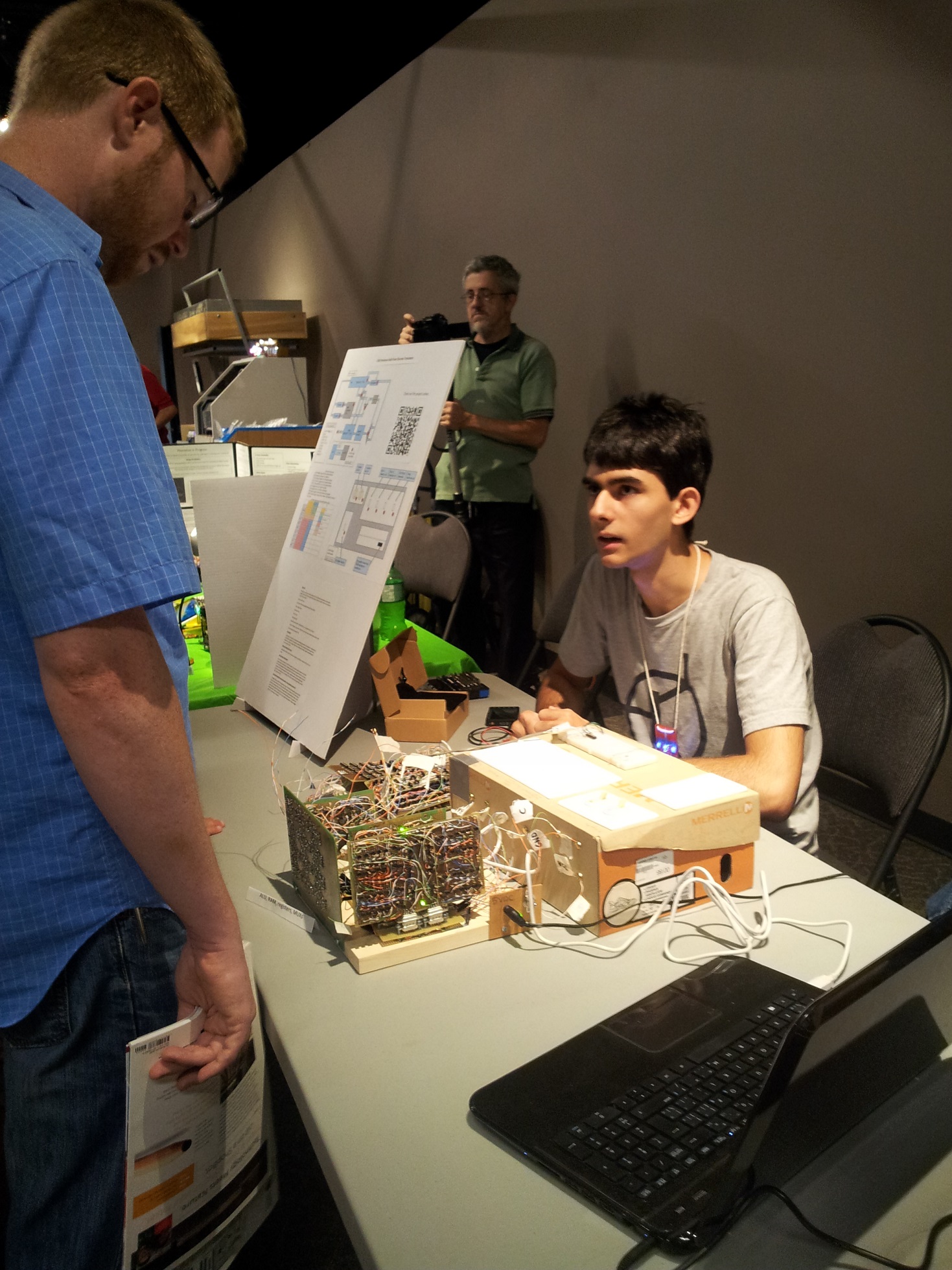
Note the discrete BJT transistor T-shirt.  Note the haunted, obsessed look in his eyes.  This fellow is building a computer out of discrete transistors.   He clearly has The Knack.  
http://hackaday.com/2014/11/22/a-4-bit-computer-from-discrete-transistors/


Our book: "SolderSmoke -- Global Adventures in Wireless Electronics" http://soldersmoke.com/book.htmOur coffee mugs, T-Shirts, bumper stickers: http://www.cafepress.com/SolderSmokeOur Book Store: http://astore.amazon.com/contracross-20

SolderSmoke Podcast #167: Arduinos, Amplifiers, Books, and Tribal Knowledge


SolderSmoke Podcast #167 is available: 

http://soldersmoke.com/soldersmoke167.mp3

3 November 2014
Who the heck is Giovanni Manzoni? 
Pete's Bench Report: 
     "Let's Build Something"  Project 
      Arduinos and Si5351s
Bill's Bench Report:  140 watt Amplifier Completed! 
      Low Pass Filter Design with the ELSIE Program
      Samlex Power Supply
     How I almost blew it up! 
     The new amp and the lids in the FT4TA pileup
Tribal Knowledge!
"Nature abhors a vacuum (tube)!"  "The Innovators" by Walter Isaacson. 
Carter, WA9DNF, REALLY knows which end of the soldering iron to grab! 
Meeting with Thomas, KK6AHT.  The two electronic cultures. 
Interviews by Chris, KD4PBJ, at Two Days in Huntsville: 
     Glen Popiel, KW5GP, Author of "Arduino for Ham Radio" 
     John Henry of TenTec
     Steve, WG0AT  


                                               Giovanni Manzoni
Giovanni Manzoni b. circa 1950 Civatavecchia, Lazio, Italy is a noted videographer specializing in the avante garde use of YouTube in ham radio homebrew settings.   Long noted for his insistence on the use of completely home-made video equipment, Manzoni went so far as to demand that his cameras and recorders only use discrete components -- he claimed that integrated circuits "freaked him out."  Manzoni's collaborators have long been puzzled by his claim that all his videos are filmed "on location."  What he means by this remains unclear, however, in a 1997 interview in QST-Italia, he was quoted as saying "No matter where you go, there you are!" 


Our book: "SolderSmoke -- Global Adventures in Wireless Electronics" http://soldersmoke.com/book.htmOur coffee mugs, T-Shirts, bumper stickers: http://www.cafepress.com/SolderSmokeOur Book Store: http://astore.amazon.com/contracross-20

Mailbag: Coils Wound Backwards, Last QSO 1981, Visions of Transistors Keeping Him Awake. Paul has THE KNACK


Hi Bill

I'm just getting back into ham radio after 33 years (last QSO: 1981),
want to do it all through homebrew, seem to have the same mindset as
guys like you and Frank K0IYE, bought your book [love it and Frank's],
and just "discovered" the Soldersmoke podcasts.  I've been listening to
them with one ear as I bike to and from work (about 40 minutes each way, so it's almost perfect).  I'm employed as a digital geek, but yearn for the days of DeMaw's prime (worked him once when he was W1CER), when the 40673 ruled.  I'm very glad that, 40 years later, people like Farhan can weave discrete analog wonders, even if they later choose to use digital *control* (NOT DSP! No!).

I had to start somewhere with your podcasts archive, so I started with
2014 and really enjoyed your struggles with the Herring-Aid 5. My 1st
receiver  was the "DC 80-10" by DeMaw from somewhere around 1970 in QST or the Handbook -- used a CA3028 as the product detector -- and I had similar struggles.  While listening to it, I immediately thought "you wound the feedback coil backwards, you idiot!"

I got my license back in March 2014 and want very badly to get back on
the air with a homebrewed, or at least minimally-kitted, station.  I've
built the receiver:  David White's (WN5Y) Beginner's and Experimenters
receiver[1] heavily modified, have a long wire antenna up, a decent RF
ground, and all the parts I need for QRP z-match tuner, swr meter, T/R
switch, sidetone, and IRF510-based transmitter.  Target:  40m CW by the middle of December, 30m in the couple of months after that with a
fully-Manhattan-style Barebones Superhet and another IRF510
transmitter.  Then one of these BitX things.  It's been a couple of
decades since I felt that there weren't enough hours in the day.  Some
nights I can't sleep, what with all these transistors and simple analog
ICs whirling around...

Anyway, keep it up, I'll be listening.

-- Paul Lender, AD0HQ

[1] I built an Arduino/AD9850 DDS -- a la AD7C -- and used it to tune a
4-crystal filter (10-cent crystals from Tayda!) for the receiver with
the same Rigol scope that you use.  I tried, really tried, to do it with
an analog RF signal generator.  Change is good.  Change is good.


Our book: "SolderSmoke -- Global Adventures in Wireless Electronics" http://soldersmoke.com/book.htmOur coffee mugs, T-Shirts, bumper stickers: http://www.cafepress.com/SolderSmokeOur Book Store: http://astore.amazon.com/contracross-20